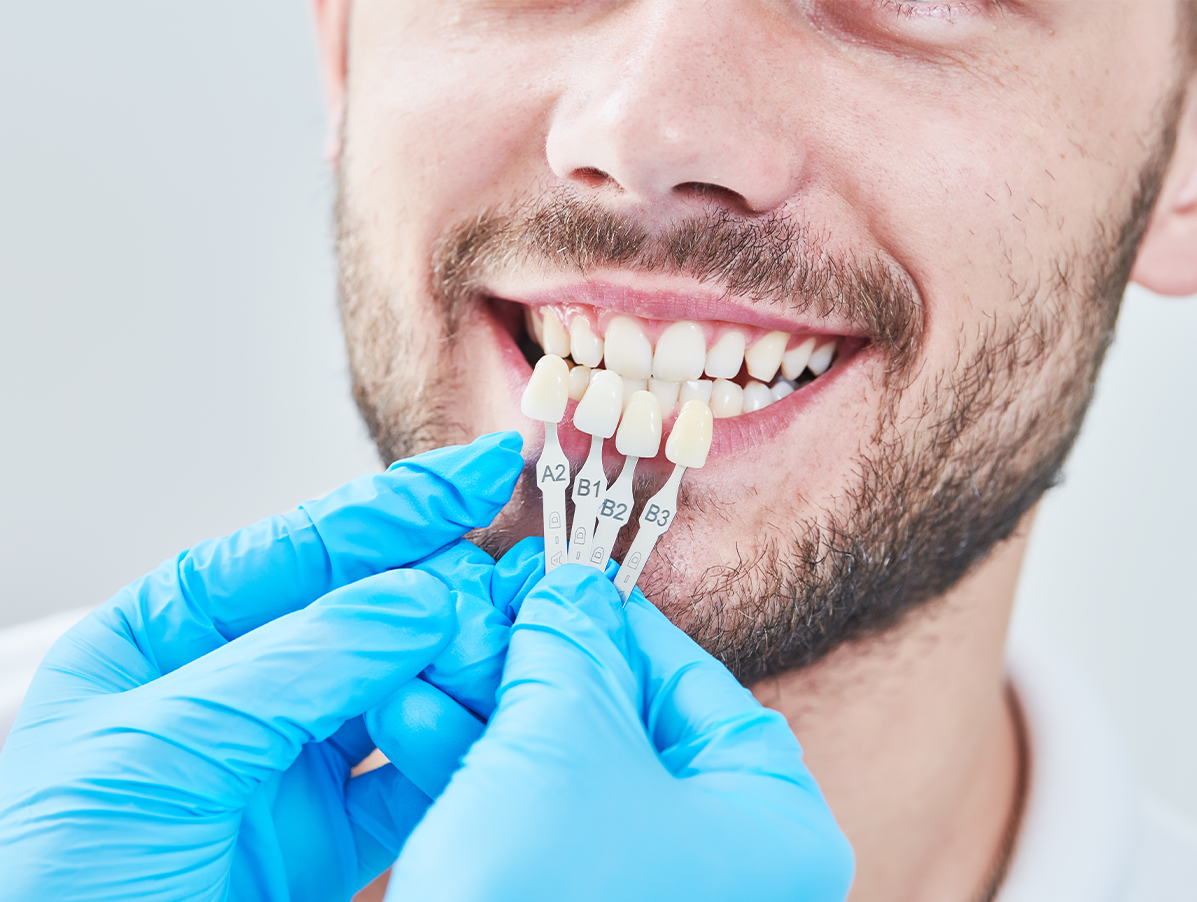
Dental veneers are applications that guarantee an aesthetic tooth appearance by safely and effectively improving the color changes, slight deviations or length anomalies, visible defects and structural defects in the enamel.
Especially for those who want to correct slight crowding, discoloration or other visible defects in their front teeth, the most effective and fastest method is a dental veneer. It is possible to have the desired smile in a few sessions. The most important factor that stands out in the field of aesthetics and veneer treatments in dentistry is naturalness. So much so that a new veneer is almost indistinguishable from a real tooth.
Tooth discoloration, fractures or other imperfections can affect the appearance and cause discomfort to the person. With dental veneers, anyone who is not satisfied with the shape of their teeth can have their imperfections removed and achieve the desired tooth appearance.
How Are Dental Veneers Made?
During the production of dental veneers, first of all, a detailed examination is made and a dental x-ray is taken. In the light of the analyzes made according to the results of the examination and x-ray films, of course, and with the patient's request also, it is decided which type of veneers will be applied to which tooth.
Before making a veneer, the dentist takes a mold of the tooth to be veneered so that it fits tightly to the tooth surface. After the measurements, the appropriate material for the veneer is selected. Then, general cleaning of the patient's mouth and teeth is performed.
Temporary ones are placed on the surface of the patient's teeth until new teeth are produced in the private laboratory. At the same time, people can understand whether the form taken is compatible with their teeth or not.
If the patients has a problem with temporary veneers on their teeth, this problem should be resolved before the real one is applied. They are made one by one in the dental laboratory and are adhered to the patient's teeth by the dentist.
They are usually made of very thin, very durable and biocompatible special materials. Depending on the type of veneer material, in some cases, a very slight roughness may be given to the tooth surface to allow it to adhere to the tooth.
What are the Types of Dental Veneers?
Dental veneers are thin layers that look very similar to natural teeth and are as strong as natural tooth enamel. They are custom made to fit the contours of the teeth and are then bonded to the enamel. When quality coatings, new bonding methods and the latest application techniques come together, it has become inevitable for them to be durable, elastic and resistant.
With routine oral care, dental hygiene and regular dental cleaning, the color of the veneers never deteriorates, stays white all the time and looks like original teeth even after years.
The type of veneer to be applied to the patient is determined after a detailed dental examination. Veneers that differ according to the materials they are made of are generally as follows:
- Zirconium veneers
- Full ceramic veneers
- Lamina porcelain veneers
- Composite laminate veneers
Zirconium Dental Veneers
Zirconium is one of the oldest and most common elements known. It is highly adaptable to the human body. In recent years, people who want to have dental veneers prefer teeth made of zirconium to metal-supported porcelain teeth. In this way, it has made its name as a frequently used method in dentistry. Zirconium teeth are very durable, very simple to use and last for years.
Zirconium is also more transparent than other options, making it extremely difficult to distinguish natural teeth. They are highly tolerant to heat and do not cause any tooth sensitivity. Zirconium veneers are in a white tone closer to natural tooth enamel than metal-supported porcelain, and dark lines are not seen on the tooth edges. In addition, since it is not metal-supported, it is not possible to leave odor and taste in the mouth.
Lamina Porcelain Dental Veneer
Laminate veneers are the process of covering the healthy teeth, which are aesthetically problematic, with laminated porcelain after they are slightly abraded.
Laminas, which are included in the aesthetic dentistry branch, are an indispensable part of smile designs. Laminated veneers, which are very difficult to distinguish from real teeth, are a very successful method of tooth restoration.
During the bonding of porcelain veneers, the tooth surface is shaved very finely, so the laminates do not weigh to the patient. They are also highly compatible with oral health. Lamina coatings have been used in the sector for many years, their forms do not deteriorate easily and yellowing is not seen.