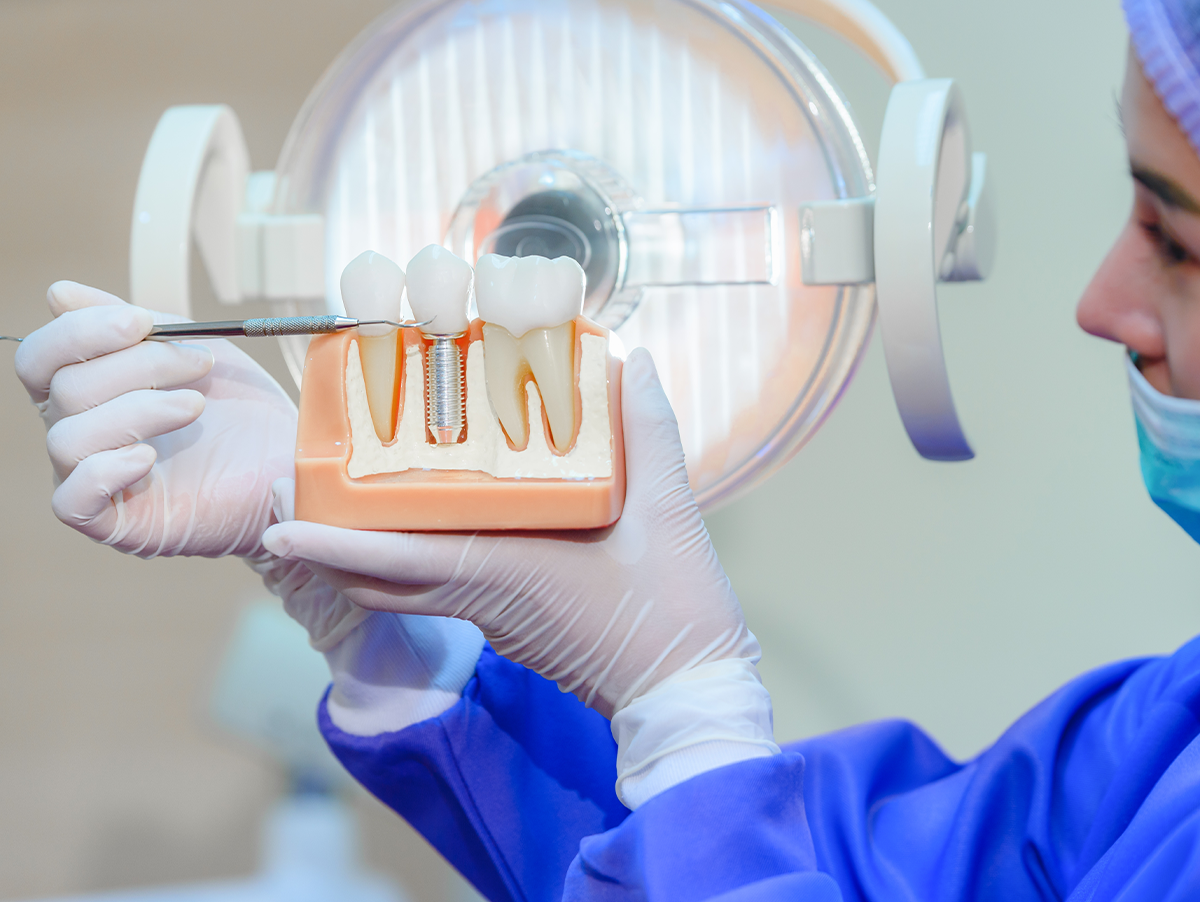
A dental implant is the name given to special screws placed in the jawbone of a person to treat missing teeth. A dental prosthesis is then placed on these screws. They are made of titanium or alloy.
One of the most important advantages over other dental treatments is that the implants do not cause any damage to the neighboring teeth. There is no need to cut the ones next to the tooth to be implanted. The inserted implant functions as a root, and actions such as eating and speaking with a natural tooth can be easily performed with the implant.
Candidates of Dental Implants Treatment
Anyone with missing teeth, over the age of 18, and whose facial development has ended can have dental implants. However, as the first step, the person's jaw x-ray should be taken and the availability of the chin structure should be checked. If there is diabetes, the person should give priority to this disease first. If the person is using blood thinners, she/he should take a break.
How is Dental Implant Surgery Applied?
After the patient's mouth and jaw structure is checked with x-rays, a low dose of sedation is applied to the patient. Measurements of bones and teeth are made. If a one-stage procedure is chosen, a temporary dental cap is placed in the patient's mouth. In the two-stage option, after the implant is placed, it is covered with the gingiva, it is expected to heal in this way and the dentures are then attached.
A temporary bridge is used in both procedures. While the recovery period is 2-3 months for the lower jaw, it is 6-7 months for the upper jaw. In some cases, new teeth are placed on the implants the same day. In this way, the person can eat easily.
There are also zirconium versions of dental implants, which are mostly made of titanium. It is preferred especially for people with narrow chin area. They are more durable than titanium. Zirconium, which is also used in dental veneers, is very close in color to natural teeth and has the ability to reflect light. They do not corrode, do not color, do not taste metal and have an aesthetic appearance.
Considerations After Dental Implants Treatment
After the implants are placed, there are things that patients should pay attention to in order for the treatment result to be successful. The following instructions of the dentist must be strictly followed.
- It is necessary not to eat or drink anything for several hours,
- Extremely hot or cold food and beverages should be avoided on the first day,
- In order to prevent swelling, cold compresses should be applied to the area at regular intervals throughout the day,
- The drugs prescribed by the dentist should be used on time and in the right doses,
- If a tampon is placed, it should be removed after one hour and gargling should be avoided to prevent light bleeding that may follow.
It is very important to rest well for the few days following implant treatment. In this process, smoking should be stopped or reduced to a minimum. After the dentures are fitted, attention should be paid to oral and dental health, dentist controls and routine care should not be interrupted.
Implants placed in a planned manner in healthy conditions can be used for many years, of course, with good care. Patients with clenching problems should definitely have a plaque made, especially after the prosthesis is placed on the implants. In this way, damage to the implants is prevented.
After the dental implants are inserted, the patient may experience body reactions such as pain, swelling and bleeding. The severity of these may vary from person to person, the number of implants, the treated area, whether there is surgical intervention and the pain thresholds of the patients. The pain seen in the treated area is expected to disappear completely within 1 week.
Who is not a Good Candidate for Dental Implants?
Dental implants may not be applied to people with the following conditions, or their current condition is expected to improve first:
- People who have not completed the development process,
- to pregnant women,
- Cancer patients, those receiving radiotherapy treatment,
- Those who use a medicine that weakens the immune system,
- Those with cardiovascular diseases, kidney failure, blood coagulation disability